Design Elements and Principles 2 d to 3 d – Stitch

“Deliverable 5. From 2D to 3D – elements and principles in CAD / Stitch.

Working with one of your 2D visual studies pieces relating to the elements and principles of design, develop a ‘2D to 3D’ outcome that evidences your skills and effort with either stitch or CAD and digital fabrication. Present the 3D outcome alongside the original 2D
drawing and use the processes of CAD or Stitch to reflect carefully on the relationship between the 2D and the 3D realm.”

img_20181109_151443_7386633156425527841628.jpg

I confess the image I have used was not one of the original 2D visual studies pieces, but a photograph I took on my way home from Usk garden centre one dreary grey afternoon. I was struck by the colours and the road disappearing into a point, emphasised by the line of the fence and the river (which you can’t see in the photo) and had to turn around, drive back and take a photo.

A couple of weeks later when we started the second round of Stitch workshops, it occurred to me that this would make a beautiful stitch pjoject on dissolvable fabric. I could use the design principle of emphasis to highlight the design element of point. The point was the vanishing point of the road and I could emphasise this by making the image circular rather than rectangular and by shaping the piece into a bowl with the point in the centre, further drawing you in.

As soon as I did my first circular sketch of the image I felt it had more of a sense of movement and definitely emphasised the central vanishing point. I could see that by bringing the edges towrds you & pushing the central point further away, this would enhance this further.

img_20181114_1030327034673309713981000.jpg

I sketched the image on dissolvable fabric and thought about the textures I wanted to create. I wanted the trees to be lacey, but the road needed to be more solid to really draw you in to the centre point. I needle felted some black fibre into some black organza and used the cording foot to ass a white cord central line, breaking it up with a zig-zag diamond stitch. I then trapped this in between the 2 layers of dissolvable fabric so that any stitches would hold it in place and also add strenth to the finished piece. I like the idea that the bottom half will be more solid and the top half with the trees dropping their leaves would be lacier and more ethereal.

img_20181116_171530_5028219038351465776075.jpg

Over the next couple of weeks I built up layers of colours and foliage with the free-embroidery foot on the sewing machine, being careful to go over any straight stitched lines with a zig zag to make sure nothing fell apart when the fabric was dissolved. As I was stitching I decided it would be a bit odd as a perfect circle, so let some of the stitching escape the confines a little to give a more organic feel.

At this point it’s still a 2d image – just drawn in thread rather than pencil or paint.

img_20181121_132641_6355707998224407883130.jpg

In order to turn it into a 3d object I cut the excess dissolvable fabric away, dunked it in a bowl of cold water for 2 minutes, squidged it to disperse the glue throughout the piece and squeeze out excess water and placed it inside a bowl, teasing each branch out with a needle and into the position I wanted it. I have done something similar with crochet before, but the thread is much thicker and easier to tease into position! I then left it for 24 hours to  dry and become stiff.


I am delighted with the final outcome. It wouldn’t make a practical bowl as it is quite delicate – definitely form over function. I was a little disappointed with the colours – the glue gives it a permanent wet-look, so the colours are much darker, duller and more subdued than I had intended. Conversely there were unexpected things that I hadn’t anticipated that you inly get from a 3d object, like the spidery shadows cast when light shines through it. Overall I believe it meets the brief – it showcases several techniques that I have learned over the last few weeks of stitch workshops and demonstrates the element and principle of design that I selected as I had intended.


Ceramics – slip-cast mould making

The first step in slip cast mould making is to decide how many pieces you are going to have to make the mould out of – check for existing casting lines, alternatively where are the natural circumferences, are there any bits sticking out or indentations that will make it impossible to remove the object from the plaster once it is set? Mark the lines along which the pieces of the mould will need to run, and where the clay will need to be built up to.

In my case, as I chose a spherical shape, it was best to have 2 pieces – the line needed to be around the widest circumference point. The best way to find this was marking a set square with white china marker and holding it as in the second picture, turning the vase around so that the white was left on the widest part of each ridge.

Get a board and either start building up the clay around the object up to the lines you have marked, or if the object needs to be set at a specific angle, set it in a little clay first, then build it up.

The clay will need to be  a minimum of 4cm deep at it’s thinnest points in order to ensure that the mould will be thick enough to cool the casting slip sufficiently. Don’t make it too much thicker as then it will take too long to dry.

Make a ‘spare’ to fill in any holes so that the plaster doesn’t fill the object and make it impossible to remove. This will also create a pouring hole for casting. As such, even if the object you are casting is solid, you will still need to make a spare for pouring.

If your object is circular, use a sheet of plastic  and string tied tightly with slip-knots to wrap around the clay, otherwise use cottling boards. They need to be tight in order to prevent seepage of plaster. As an added measure, always cover any joints on the outside with wet clay – you don’t want it going all over the floor.

Mix plaster according to quantities on wall chart. Always wear a mask and make sure the extractor is on when measuring plaster. Once it is in the water it’s fine – you just don’t want to breathe in the dry plaster powder. Make sure that the yellow bucket is rinsed and that you don’t ahve any flakes of set plaster floating around in it. Leave plater and water to sit for 2 – 3 minutes before stirring to ensure saturation. Stir with hands until combined to a regular consistency, but don’t agitate too much – you don’t want to trap air bubbles in it. Scrape off any bubbles from the surface as you would when cooking a broth, and throw them on the red plastic mat where they can be scraped off when dry. Once it has thickened and you can draw a figure 8 in it and see a slight trail, pour the plaster into the mould over your hand (to distribute it evenly & stop your object from being dislodged by the force). Leave for 20 minutes before removing cottling boards/plastic and string.

Flatten top with the plaster grater, turn over and remove clay and clean off with a wet sponge. I forgot to take a photo of this but, but put in ‘natches’ with a 2p piece (indentations and protrusions that will help place your mould together correctly when finished).

Soft soap the plaster, including about an inch down the sides with a small sponge, then wipe it off with a wet sponge (get a jug of water to rinse sponge). Repeat, then put a third wash of soft soap on but this time don’t rinse it off, just remove any bubbles with a dry brush.

Replace cottling boards or plastic and string, re-clamp gaps with wet clay and repeat the plaster mixing and pouring process. Et voila!

After Modernism – Tate Modern and Tate Britain trip

We went to Tate Modern to see some of the pieces we had been discussing in our lectures/seminars in real life. The idea was that they might have more of an impact on us that the photo’s. In some cases this was true, but in the case of Carl Andre’s Equivalent VIII below, I’m afraid it had the opposite effect on me. In theory I can see that it is an example of minimalism – the use of a single material – 120 firebricks stacked 10 x 6, 2 deep, the simple geometric shape, human sized so not making a grandiose statement about being an impressive sculpture. No plinth or showcase – “what you see is what you see” (a phrase commonly attributed to Frank Stella). No hidden meanings, although it was discussed that the size and shape is reminiscent of a tombstone, especially with the low rail around it to stop visitors getting too close.

But I still find it incredibly irritating. It is just a pile of bricks like you would see on a pallett in B&Q and walk straight past. I get it, but I just don’t appreciate it! Not my cup of tea.

I felt a bit differently about Roni Horn’s ‘Pink Ton’. It still has the same minimalist qualities – single material, big but not larger than life (although it weighs a tonne, it isn’t much bigger than a kitchen table), a simple glass cube not pertaining to be anything else. But it’s beautiful and interesting. I love how it changes as you walk around it because of the light and the surface texture. In the light you can see it is pink glass and the rough outer texture is just where it sat in the mould, but away from the light it looks like it’s been painted with pink paint all around the outside. Where the glass curves at the edges, a naturally occuring effect from the mould process, it almost creates an optical illusion – you don’t know how deep the glass is as it distorts the perspective and the light reflections on the smooth surface make interesting patterns…so whilst it is still a minimalist piece, I still found it to be beautiful and interesting. I still think, personally, that in order for an object to be considered art, it needs to have that special something about it.

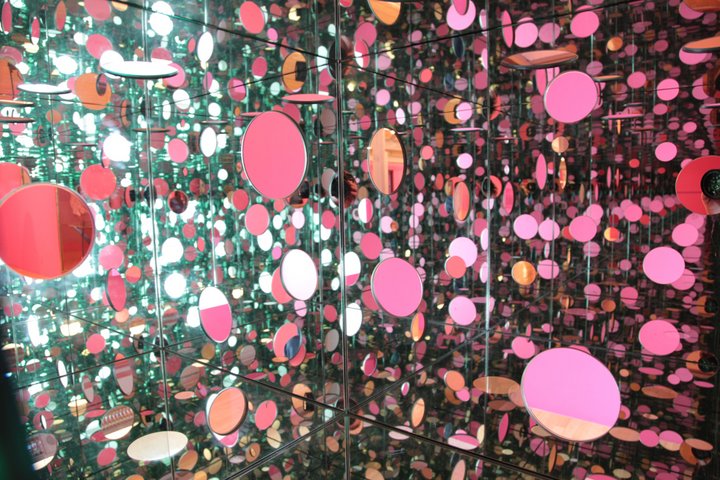
And the Kusama mirror cube piece!  I am using a photo of this piece that was put on moodle as one of my inspiration pictures for my 2d to 3d piece, so it was wonderful to see it properly.  Again, something simple and minimalist – one material, simple geometric shape, not too big or small, it is what it is, but the patterns and colours from reflected clothing that it created were the opposite of minimalism! It gave me a new perspective on why she calls them infinity cubes – I had thought it was because the reflections appear to go on forever, but also the combination of patterns and colours are infinite and constantly changing.

After the Between Object and Architecture display that had been the purpose of our visit, we were set free to explore on our own. I found another Barbara Hepworth sculpture – I am fast becoming a fan of hers!  I have said it before but her sculptures are so tactile and inviting, which isn’t a good thing when they’re in a gallery and you aren’t allowed to touch them!  Smooth like an eggshell on the outside, yet you can see the making marks on the inside – in this case it’s cast and carved plaster rather than the polished and painted wood of ‘The Wave’ that has inspired my design sheet. I love the idea that the inside is as, if not more interesting and complex than the outside.

I didn’t have long at Tate Brittain – only 30 mins, so I dashed around taking photo’s of anything that caught my eye. On looking through my photo’s I see a lot of the work that interested me was by Lynn Chadwick, who I had not previously heard of. There are obvious similarities between ‘Fisheater’ and Alexander Calders mobiles, whom we have been learning about in Facture, but they are given life and personality rather than being totally abstract and scientific. I wonder if it would move if a breeze blew through, and if so what would the movement be? It is beautiful and scary at the same time.

Woodwork Workshop – making a box properly!

First we learned how to use the band saw safely. Make sure the ventilation is on, that your hair is tied back and you have goggles on (I wear glasses so no need).  Always ensure the blade guard is approximately 1 cm from the top of the piece you want to cut – if it is too loose it will wobble and snap. Adjust the guide on the left hand side so that the blade lines up with where you want to cut (if cutting a straight line.). Never let your fingers get within 5 cm of the blade. Use the tool provided to push the last bit of wood through. Let the blade do the work – don’t push too hard – just feed it in. Once the wood is cut, turn it off and wait for the blade to come to a complete stop before removing wood from plate.

To make a perfect wooden box with a perfectly fitting lid, measure your wood and cut to size using the band saw.

Make rebate joints by measuring the thickness of the wood and dividing by 2. Mark a line half way, then mark a line on the inside face of the box the same depth (i.e. if wood is 2 cm thich, mark a line 1cm in. Use the band saw to cut out the rebate corners on both ends of each piece of wood, making sure you know which is to be the inside & the outside.

Glue together with wood glue and clamp whilst it dries. Use set square to make sure the corners are all at right angles.

Once dry use the sanding wheel to smooth off the open ends. Always make sure the extraction is on and the you only use the bottom right side of the wheel, so the item you are sanding is pushed down into the plate, not up into the air.

Once smooth, get 2 pieces of wood to form the top and bottom of the box. These should be slightly bigger – the excess will be sawn and sanded off later. Glue the top and bottom on, but this time be sparing with the glue so that it doesn’t squidge into the interior of the box. Again clamp in place whilst it dries.

Once dry,  Cut off the excess with the band saw, then sand all sides using the sanding wheel.

To get rid of the rotation marks and get a perfectly smooth finish, use the hand sanders, starting with a coarse grain sandpaper to remove the circular marks, then a medium grain, then a fine grain.

You now need to use the band saw to cut the lid off the box – make sure there is at least 1 cm below the line of the wood. Sand both open edges gently with the fine grade sander – you want a smooth finish, but you still want a well fitting lid – the rotary sander will take too much off.

You can now either stain or put a protective layer of wax on. Once you have the finish you want, attach hinges and catch. Gently clamp the box together so it doesn’t move, use a braddle to mark where the screws are going and attach. If you have 4 screws to put in on a hinge, do opposing corners to ensure that it stays in place.

Yayoi Kusama – Infinity – The Cube, Bristol 05/08/2018

I hadn’t seen any of Yayoi Kusama’s work except for the big yellow pumpkins with the black spots in the mirror room – and then only because it made the news when someone broke one of the pumpkins while trying to take a selfie!

When Emma invited me to go see the film about her life and her work I decided I would like to know more.

Kusama Movie

According to the film, she had a conservative and challenging upbringing – her mothers family ran a successful seed production company and when she married, her husband unusually took on her surname, suggesting he felt emasculated. It was not a happy marriage, he had many affairs, she became bitter and sent her children out to spy on him. It was hinted that Yayoi encountered her father being unfaithful with a lover in a field of flowers on the farm. It is implied that this image in her mind of being in a field of infinite flowers at a traumatic time may have inspired her obsession with dots and infinity. As she grew up, her mother took her art materials away and told her she needed to find a husband and start a family, but she rebelled.

Image result for yayoi kusama early work

Yayoi Kusama – On the Table – Tate

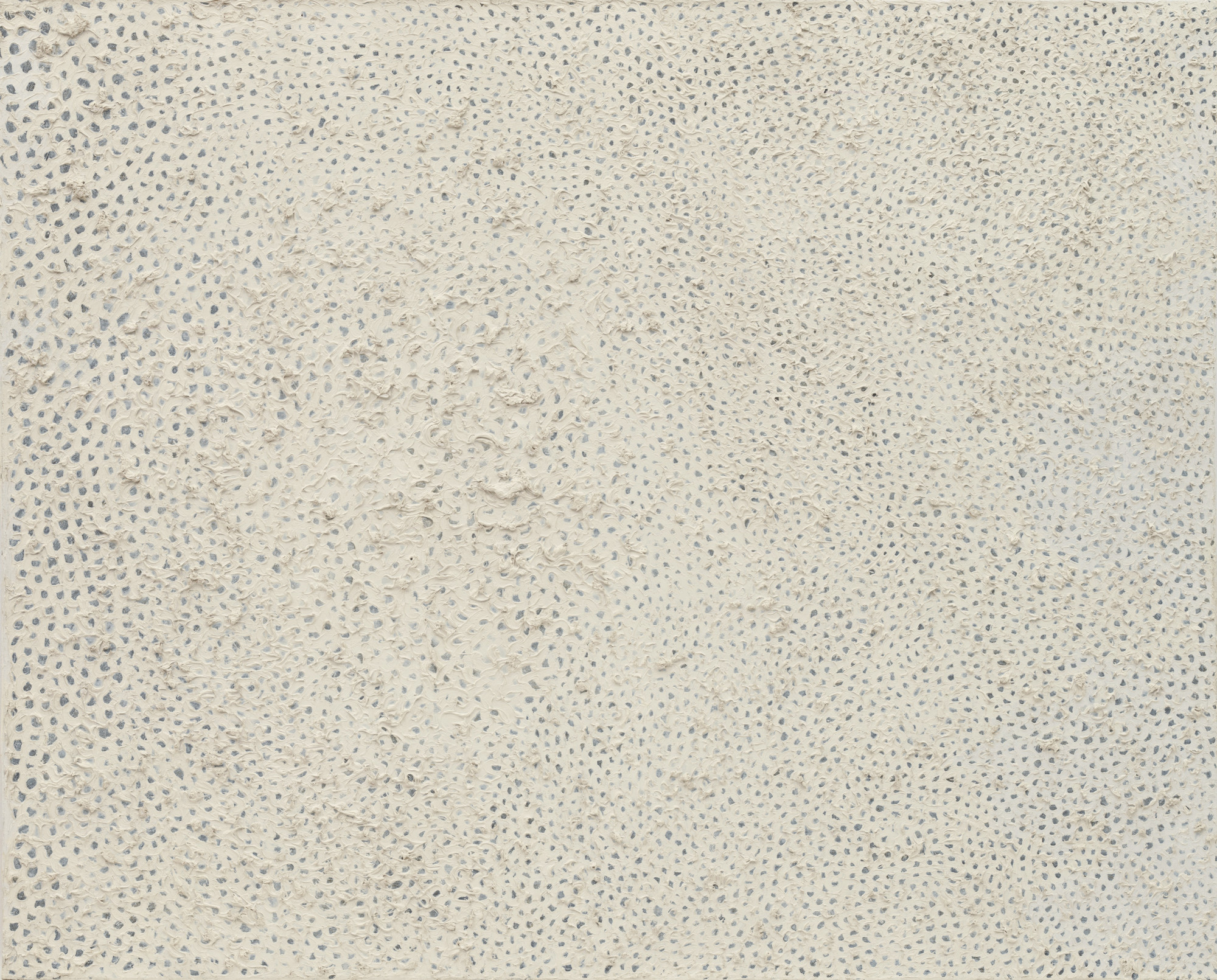
She tried to sell her work in her home city, but was only moderately successful and she made contact with Georgia O’Keefe, who encouraged her to bring work over to America. She decided to travel to New York to seek more freedom, fame and fortune (a very risky and difficult thing to do at the time!). She tells how when she looked down from the plane she saw the waves on the ocean and thought they looked like nets reaching out for infinity, inspiring her series of huge net paintings.

Image result for yayoi kusama net paintings

Yayoi Kusama – No. F. 1959 – Moma

Once in New York in the 1960’s and ’70’s she had to be a tough and pushy to get her work shown – as a racial minority and a woman, she was often ignored by the major galleries but she didn’t let that deter her – she fought hard to get her work shown, getting a reputation as a difficult client, but was determined to hold on to her identity as a Japanese Woman, wearing traditional Kimono to private views and opening events. She famously installed herself, uninvited, just outside the Venice Biennale of 1966! She found that her work still didn’t get the recognition it deserved, with many artists such as Andy Warhol, Claes Oldenberg & George Segal taking inspiration from (and credit for, as she saw it!) her ideas and work.

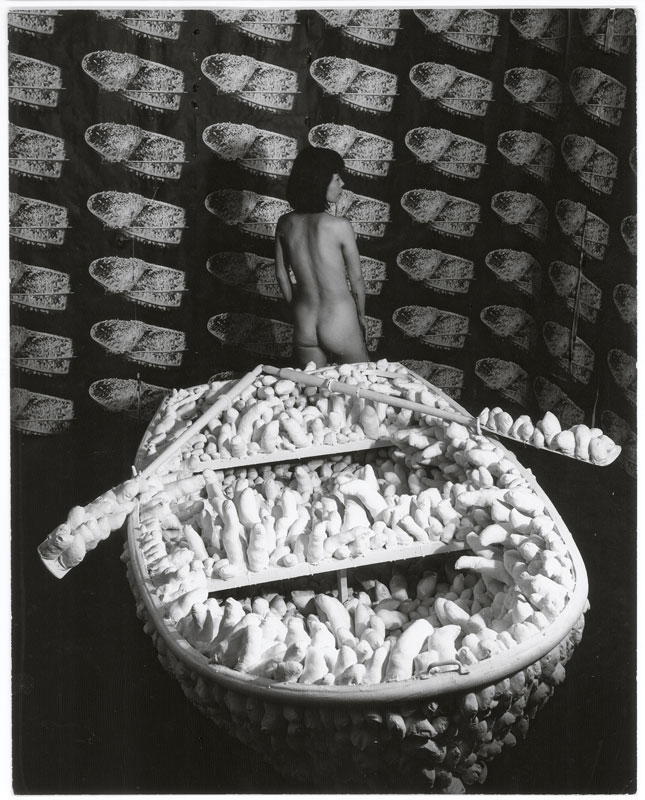
Image result for yayoi kusama boat

Yayoi Kusama – One Thousand Boats – Tate

She now works primarily in sculpture and installation, but in the 1960’s held many ‘happenings’ involving nudity and polka dots and has made films, written poetry and of course made her series of infinity net paintings.

Her mental health has influenced her art and the film covered this aspect, explaining how seeing the misery her fathers adultery caused left her with a fear/dislike of sex, influencing her ‘penis chairs’ and other objects such as boats covered in fabric phalluses. Her desire for fame left her depressed and suicidal on several occasions and she has been voluntarily living in a psychiatric hospital since her return to Japan in the late 1970’s.

Overall it was a fascinating film giving insight into what her work represents and how her art is her life and her life is her art. I have not been inside one of her infinity rooms in real life, but it is now one of my goals!

Her work obviously links into what we are currently learning across Facture and Concept. Her trademark dot is a design element, so her work is an obvious choice for inspiration for our 2d to 3d design outcome project.

Image result for yayoi kusama

Yayoi Kusama – The Passing Winter 2005 – Tate

It’s also interesting to see where she fits into the Abstract expressionism/pop art/fluxus discussions we are having in our After Modernism lectures for Concept. We have been learning about Claes Oldenberg and his pop art installation ‘The Store’, and in the film, Yayoi Kusama states that Claes never used ‘soft sculpture’ until after he saw and was inspired by her penis chairs. The film also claims that Andy Warhol took the idea of repeating images from her installation of the penis boat, where she covered the walls and floor of the installation with a repeated image of the object itself, yet she has not been mentioned in our lectures. Perhaps she is over-stating the influence she had, or perhaps the sexism of that period is still reflected in our learning.

The film claims she is now the top selling female artist in the world, however I can’t help but feel there’s an emphasis on the word ‘female’. Have things really improved for female artists? I think of Lubaina Himid’s Turner Prize win earlier this year – seen as a big win for female artists, but it was for work produced in the 1980’s…are we catching up?


Metal workshop – use of machinery and mould making with vinamold

Basically a guillotine for metal. Mark line where you want to cut on metal. Place metal on table and feed into machine until the line matches up with the line of the blade. Stand on pedal. Mind your fingers!

Electric/air powered snips and cutters. Make sure you turn off the air once you’ve finished. I would say wear goggles, but I wear glasses anyway.

Sanding wheel. Always use bottom right hand side.

Band saw. Same as for woodwork – keep guard as low as required for piece you’re cutting, never place fingers within 5 cm of blade – use a tool to push if required. If you are cutting close to the left habd edge use the guide.

Bending rollers. Put metal between rollers and wind the handle to bend. adjust the proximity of the rollers to increase or decrease the amount of bend.

Giant loppers!  Also takes 2 cm notches out. Mind your head.

Giant tin opener – cuts out circles of metal.

Most important thing – if you’re in any kind of trouble the first thing you do is hit the stop button to cut the power and stop the machinery.

Another metal bender, but this onebends at an angle rather than a curve. See below.

Plasma cutter. Always draw the curtain when using this area to stop passers by getting eye injuries from the light. Always wear protective goggles, apron and gloves from the cupboard in this area.

For vinamould casting, select a non-porous object to cast. Make a clay surround for your object, leaving a cm or 2 all the way around. Use a board so you can carry it away with you – don’t leave anything lying around or it will be re-used…

Chop up vinamould into approx 1 inch cubes to check for lumps of plaster or any bits of metal – remove anything you find. Make sur you have enough to cover your object – better safe than sorry. If you don’t melt enough, you can add more afterwards but there will be a line of weakness. Best to do it all in one go.

Microwave for 5 mins, stir and microwave for a further 3 mins. Stir again. Stirring is very important – makes sure that the heat is distributed evenly. Always use a wooden spoon as metal can shock it and cause it to explode all over your hands, causing nasty burns. If still lumpy, heat for another couple of minutes. If it’s all melted, carry on.

Pour over object, making sure the whole thing is covered with a centimetre or 2 of vinamould over the object.

Any leftovers, pour on floor to cool quickly and so it’s easy to chop up for the next person.

Leave to cool completely before removing object.

When mould is ready, pour in casting wax.

Edinburgh – Scottish National Gallery and Scottish National Galleries of Modern Art 1 & 2.

Whilst in Edinburgh for a family wedding, we spent the day exploring a few art galleries. Below are the photo’s of art that I found interesting or inspiring . I have included photo’s of the accompanying information and so won’t discuss every piece – there are far too many and you’ll be bored stiff! There are a few that have influenced my deliverables and I will discuss those further in the relevant posts (e.g. the Barbara Hepworth piece has influenced my design sheet and the Mondrian has influenced my elements and principles of design 2d to 3d – see relevant blog posts for further discussion and my personal writing about these pieces.).

Stitch Workshop – weeks 1 to 3

The first 3 weeks of stitch were mainly getting used to working with a sewing machine. I have never got on with machine sewing, turns out I was missing a lot of the basics!

Things I didn’t know:

When winding a bobbin, hold the thread in the air and keep hold of it until the thread has wound it’s way up and down the bobbin. Stop winding, cut the thread at the top of the bobbin as it will now be secure and carry on winding until the bobbin is full. If the bobbin isn’t wound with an even tension it will totally ruin your work as the bottom stitches will be loose and useless, so keep a steady foot whilst winding and keep an eye on the bobbin, making sure it winds smoothly and evenly.

I think I’ve got this now, but I struggled a ridiculous amount with bobbins!  thread should go anti-clockwise, under both catches & put the cover back on. To lift the thread, thread the top of the machine, holding the upper thread, twist the manual knob towards you until you see the lower thread move across the bobbin, then pull the upper thread. The lower thread should come up as you pull.

img_20180926_1147421063699228.jpg


Always make sure that the needle is in the highest position before threading – this ensures that the tension thingy is open and that the thread will be positioned correctly and have the correct tension. The tensiod dial should always be between 4 & 5.


Seems pretty obvious, but select the stitch you want to use and the stitch legth and width required for that stitch are shown in the little gauges. Adjust the knobs accordingly.

For free stitching, change the foot to the spring loaded one by unscrewing the screw using the screwdriver provided. Change foot & screw it back in. Be careful of the needle whilst doing so!

When free stitching, use a disappearing marker rather than chalk – it will just disappear after an hour or so – no need to wash away the chalk.

When stitching on dissolvable fabric, use a biro. Don’t get it wet. Use it folded in half so that it doesn’t disintegrate. You can trap things such as felt between the layers if you wish.

When stitching a garment, always use strong thread. Seam allowances should be 1 – 1.5 cms. Always work through your pattern before starting to check the order of things. Always make a rough version with cheap fabric first to check for unforseen issues.

Design a site like this with WordPress.com
Get started