I hadn’t seen any of Yayoi Kusama’s work except for the big yellow pumpkins with the black spots in the mirror room – and then only because it made the news when someone broke one of the pumpkins while trying to take a selfie!
When Emma invited me to go see the film about her life and her work I decided I would like to know more.
Kusama Movie
According to the film, she had a conservative and challenging upbringing – her mothers family ran a successful seed production company and when she married, her husband unusually took on her surname, suggesting he felt emasculated. It was not a happy marriage, he had many affairs, she became bitter and sent her children out to spy on him. It was hinted that Yayoi encountered her father being unfaithful with a lover in a field of flowers on the farm. It is implied that this image in her mind of being in a field of infinite flowers at a traumatic time may have inspired her obsession with dots and infinity. As she grew up, her mother took her art materials away and told her she needed to find a husband and start a family, but she rebelled.
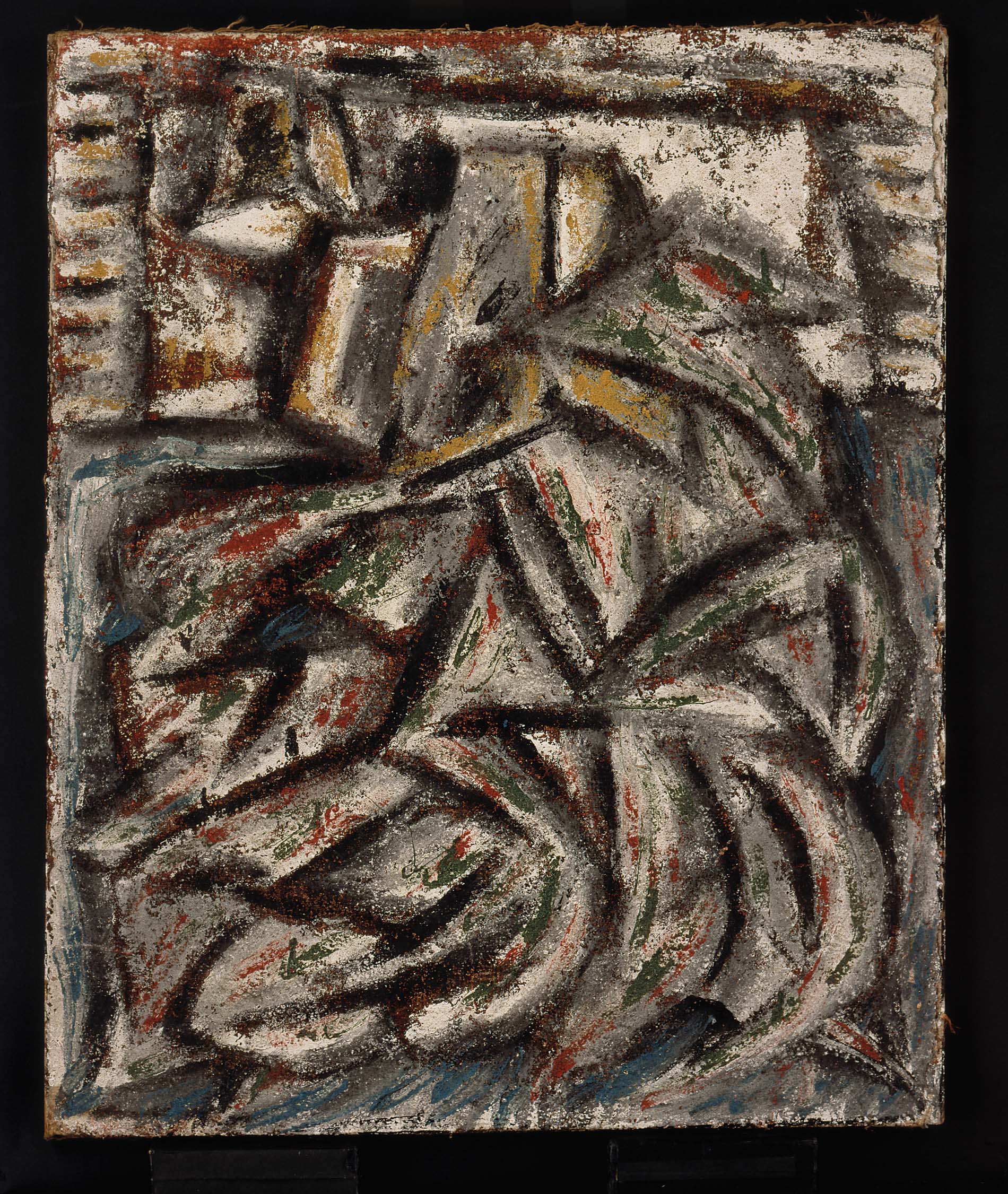
Yayoi Kusama – On the Table – Tate
She tried to sell her work in her home city, but was only moderately successful and she made contact with Georgia O’Keefe, who encouraged her to bring work over to America. She decided to travel to New York to seek more freedom, fame and fortune (a very risky and difficult thing to do at the time!). She tells how when she looked down from the plane she saw the waves on the ocean and thought they looked like nets reaching out for infinity, inspiring her series of huge net paintings.
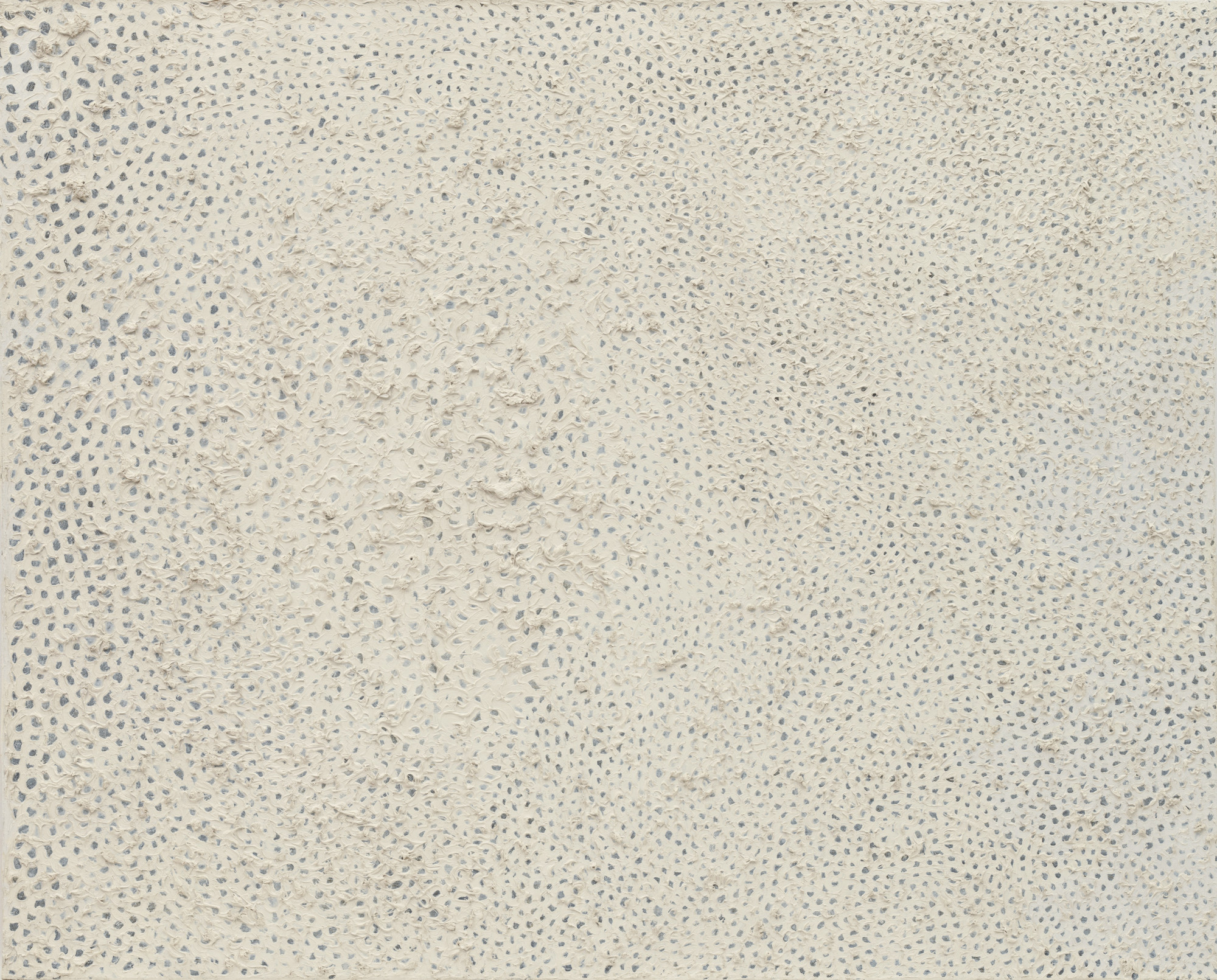
Yayoi Kusama – No. F. 1959 – Moma
Once in New York in the 1960’s and ’70’s she had to be a tough and pushy to get her work shown – as a racial minority and a woman, she was often ignored by the major galleries but she didn’t let that deter her – she fought hard to get her work shown, getting a reputation as a difficult client, but was determined to hold on to her identity as a Japanese Woman, wearing traditional Kimono to private views and opening events. She famously installed herself, uninvited, just outside the Venice Biennale of 1966! She found that her work still didn’t get the recognition it deserved, with many artists such as Andy Warhol, Claes Oldenberg & George Segal taking inspiration from (and credit for, as she saw it!) her ideas and work.
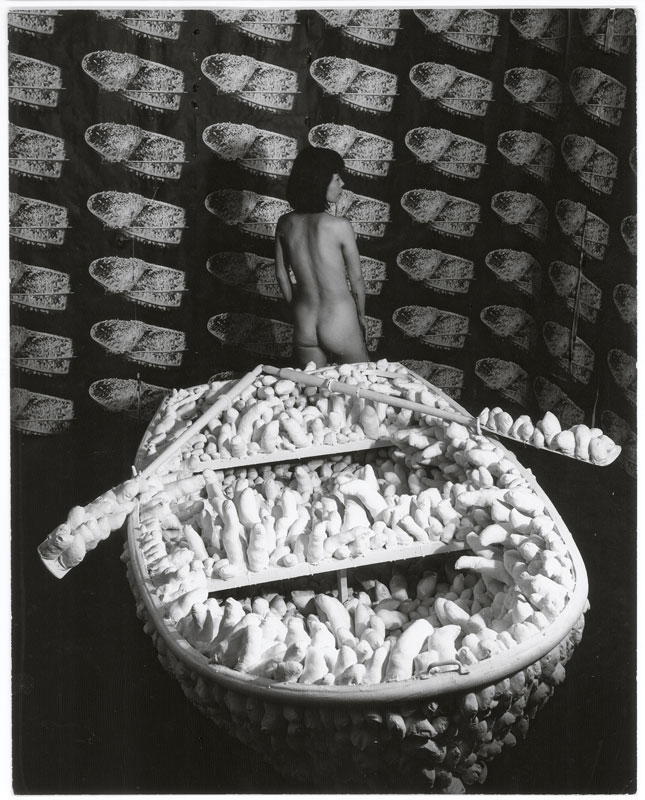
Yayoi Kusama – One Thousand Boats – Tate
She now works primarily in sculpture and installation, but in the 1960’s held many ‘happenings’ involving nudity and polka dots and has made films, written poetry and of course made her series of infinity net paintings.
Her mental health has influenced her art and the film covered this aspect, explaining how seeing the misery her fathers adultery caused left her with a fear/dislike of sex, influencing her ‘penis chairs’ and other objects such as boats covered in fabric phalluses. Her desire for fame left her depressed and suicidal on several occasions and she has been voluntarily living in a psychiatric hospital since her return to Japan in the late 1970’s.
Overall it was a fascinating film giving insight into what her work represents and how her art is her life and her life is her art. I have not been inside one of her infinity rooms in real life, but it is now one of my goals!
Her work obviously links into what we are currently learning across Facture and Concept. Her trademark dot is a design element, so her work is an obvious choice for inspiration for our 2d to 3d design outcome project.
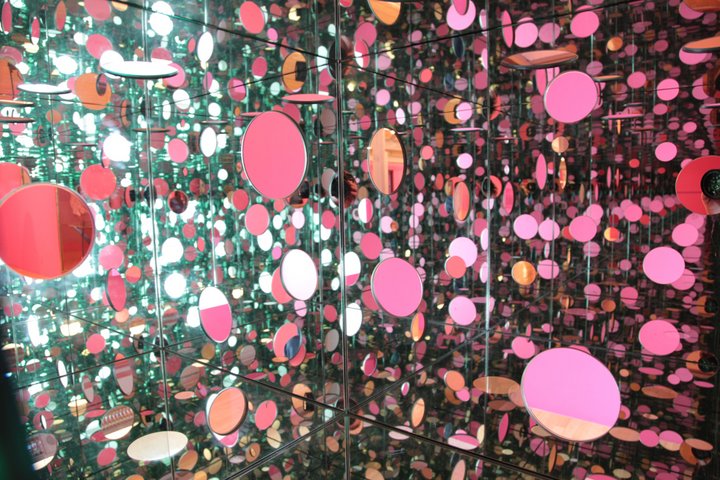
Yayoi Kusama – The Passing Winter 2005 – Tate
It’s also interesting to see where she fits into the Abstract expressionism/pop art/fluxus discussions we are having in our After Modernism lectures for Concept. We have been learning about Claes Oldenberg and his pop art installation ‘The Store’, and in the film, Yayoi Kusama states that Claes never used ‘soft sculpture’ until after he saw and was inspired by her penis chairs. The film also claims that Andy Warhol took the idea of repeating images from her installation of the penis boat, where she covered the walls and floor of the installation with a repeated image of the object itself, yet she has not been mentioned in our lectures. Perhaps she is over-stating the influence she had, or perhaps the sexism of that period is still reflected in our learning.
The film claims she is now the top selling female artist in the world, however I can’t help but feel there’s an emphasis on the word ‘female’. Have things really improved for female artists? I think of Lubaina Himid’s Turner Prize win earlier this year – seen as a big win for female artists, but it was for work produced in the 1980’s…are we catching up?





 clairemaloney